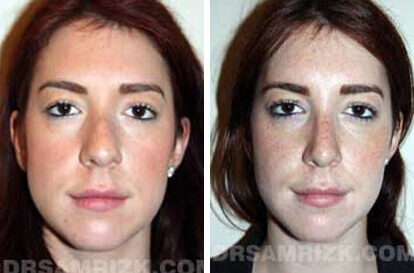
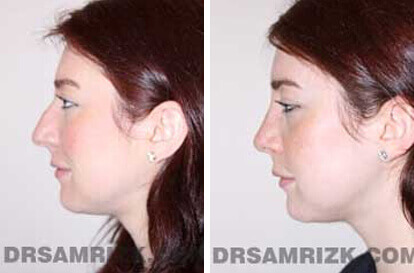
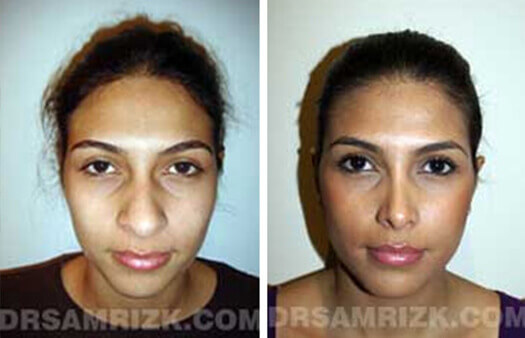
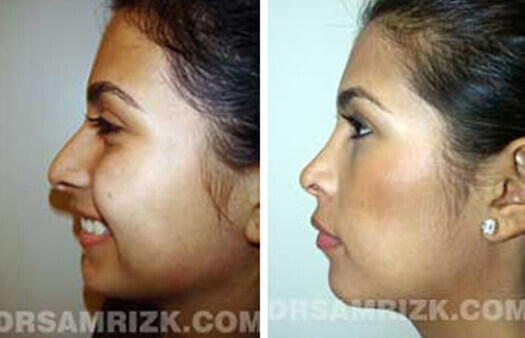
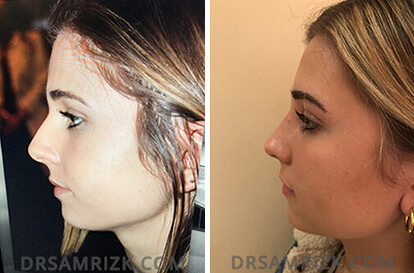
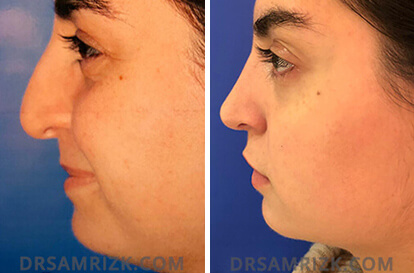
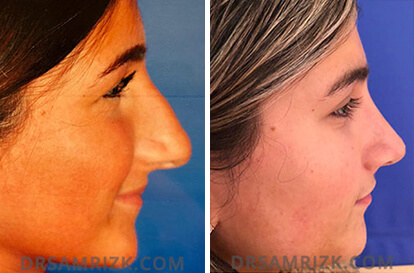
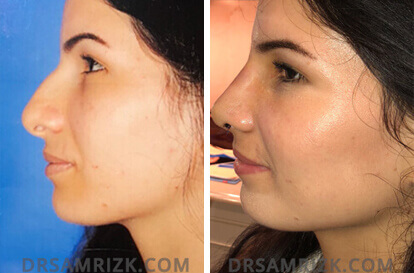
| |

Nose Surgery/Rhinoplasty/Revision Rhinoplasty Septoplasty/Sinus Surgery
Dr. Rizk works with most insurance benefits for any medical issues in nose as an out of network doctor. Call the office to find out more.
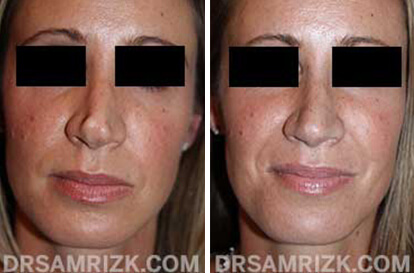
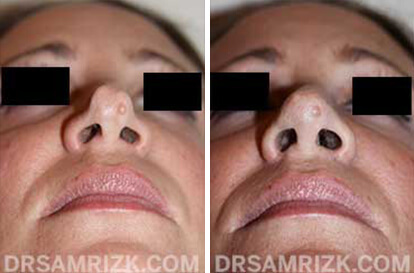
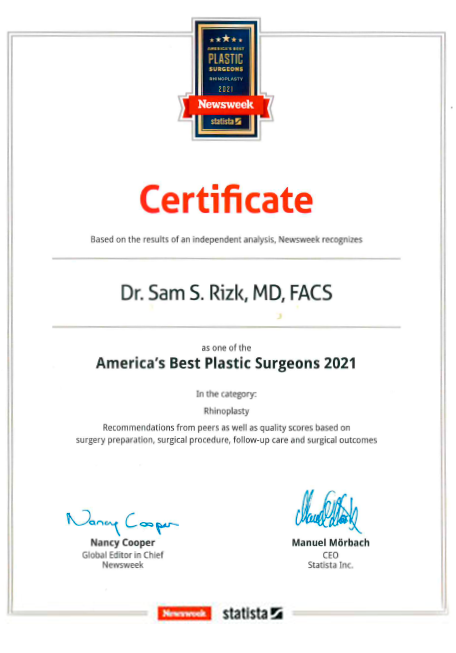
Dr. Rizk is a double board certified subspecialist in the nose and face - he DOES NOT perform breast or other body plastic surgeries. Rhinoplasty is a plastic surgery procedure performed to reshape, reduce or augment a person’s nose. Dr. Rizk can remove a bump, narrow nostril width, change the angle between the nose and the mouth, as well as correct injuries, birth defects, or other problems that affect breathing, such as deviated nasal septum or a sinus condition. Rhinoplasty is usually an outpatient procedure performed under either local or general anesthesia and lasts one to two hours.Dr. Rizk is a well respected New york rhinoplasty surgeon, international educator and teacher with a practice on Park Avenue, NYC who is known for his noses, which are unique, natural, and complement a person's face. Dr. Rizk has performed thousands of rhinoplasty procedures, half of which are revision rhinoplasties. He is sought-after throughout the United States and the world, having done royalties, celebrities, entertainers and people
from around the globe. With each brushstroke, Dr. Rizk files, refines, and sculpts to create a unique nose in harmony with a person's face. Dr. Rizk's unique tools and techniques allow a PRECISION OPERATION with a PAINLESS and RAPID RECOVERY. Additionally, and very important is improvement in breathing. Good breathing is necessary for a good night sleep, for energy, as well as a healthy heart. If a patient has a SIGNIFICANT (greater than 50% blockage) deviated septum compromising the breathing, this can be repaired simultaneously as rhinoplasty. Many revision surgeries Dr. Rizk performs are done to restore collapsed areas that were resected too much in previous surgeries, not just to improve the cosmetic appearance, but also to restore the ability to breathe, which is vital to life.
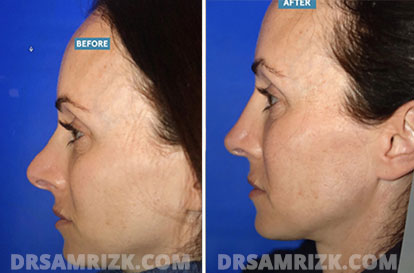
Dr. Rizk employs both the advanced open (external) and closed (endonasal) surgical techniques to naturally sculpt the nose with a rapid recovery. Dr. Rizk innovated suture reshaping techniques for cartilage sculpting rather than removal. Dr Rizk is well known for his revision rhinoplasty method which restores the patients’ ability to breathe in addition to improving nasal appearance by rebuilding previously removed cartilage or bone. Additionally, patients with breathing or sinus problems can combine functional repair with an aesthetic result. Dr. Rizk’s innovative techniques employing this combined approach were published in Annals of Plastic Surgery (1997). Typical recovery time is 5-7 days with minimal or no bruising and virtually no discomfort. Dr. Rizk is a regularly scheduled lecturer and panelist for rhinoplasty worldwide.
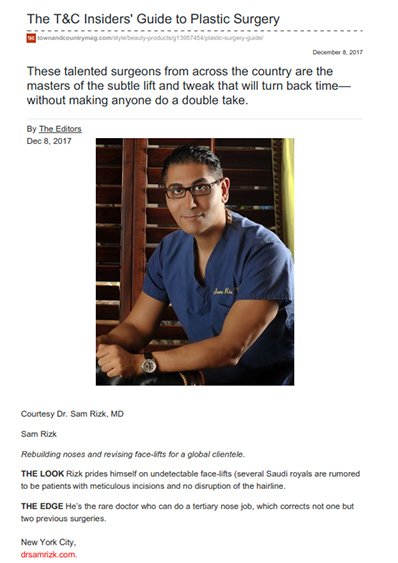
The attention to details and his focus on achieving natural looking results while using the latest surgical techniques was recognized by
Tatler magazine, which featured him recently as one of the world's top rhinoplasty surgeons.
Dr. Rizk's philosophy on rhinoplasty
"It is better to focus on a few plastic surgery procedures and do them
exceptionally well than to do all types of plastic procedures all over the
body just well - My practice is highly specialized in the nose and face only - sort
of a specialist within a specialty of plastic surgery. A beautiful nose is a natural
one that compliments and fits harmoniously with a patient's face. I do not believe in a
universally ideal nose, only an ideal nose for a particular face. I
believe the nose is one of the most artistic parts of one's face and
cultural differences should be respected in changing a nose. I also do
not like upturned, scooped out, or excessively pointy noses. I believe
and have pioneered techniques to give you a natural nose with tiny
hidden incisions and a rapid recovery. Every nose that I do is different
as every face is different and a customized, individualized approach
describes my techniques."
What is different about Dr. Rizk's methods and
techniques?
Dr. Rizk has pioneered a THREE DIMENTIONAL HIGH DEFINITION RHINOPLASTY SURGERY
in New York office which has the main advantage of PRECISION in changing structures
and LESS TRAUMA with a much QUICKER RECOVERY. Dr. Rizk performs both
endoscopic (endonasal) rhinoplasty through small intranasal incisions
and open (external) rhinoplasty done through a small inconspicuous
incision at base of nose. The 3-D high definition rhinoplasty simply
put lets the surgeon see the structures so clearly before modifying
them. For instance, instead of simply filing down a bump and deciding
how much to remove by looking at nose from outside alone, which can be
imprecise, Dr Rizk inserts a high def. telescope connected to a
3d-high def camera system and looks at what the bump consists of
(bone, cartilage, scar tissue and addressing and sculpting it
accordingly with great precision). Additionally, Dr. Rizk pioneered
cartilage reshaping techniques with sutures which result in less
excision of cartilage to preserve a natural framework. In fact,
sometimes Dr. Rizk adds cartilage in revision surgery to collapsed
areas. This cartilage is usually obtained from the nasal septum or
the ear (auricular cartilage). Dr. Rizk may use this cartilage to
camouflage defects, support a drooping tip, elongate an upturned nose
or correct tip irregularities or asymmetries.
For more information on high definition rhinoplasty click here.
Who is a candidate?
Women as early as 14 years or males as early as 15
years may be candidates. Patients may be unhappy with a bump or a wide
tip, or large flaring nostrils, an older person might not like how the
nose elongates and the tip drops as we age. An injury might cause a
nose to become crooked. Additionally, breathing or sinus problems may
drive a patient to seek a doctor as their primary concern and they
may decide to do some cosmetic improvement at the same time. For
revision rhinoplasty, a patient may be unhappy with a nose done a long
time ago with a scooped out look, an unnatural upturn, excessively
pointy tip or collapsing, asymmetrical areas. Some patients may
request only profile changes or only tip changes or both. A subtle alteration in one's nose can greatly improve one's appearance. Good health and realistic expectations are pre-requisites. Dr. Rizk may choose not to operate on perspective patients who he feels may not be good candidates for rhinoplasty.
How long does rhinoplasty take?
Revision rhinoplasty may take up to 3-4 hours depending on scar tissue and graft usage and harvesting tissue from other areas. Dr. Rizk does a very meticulous operation and does not rush. Dr. Rizk also feels that surgical times longer than 4 hours result in diminishing returns due to irreversible stretching of skin and sometimes very prolonged swelling. Furthermore, the nose swells up so much with longer surgical times that it becomes impossible to assess nuances in the shape of the nose. This is why Dr. Rizk spends time creating his surgical plan prior to the surgery with detailed diagrams to decrease operative time.
How do I choose a surgeon?
A surgeon who specialized in facial plastic surgery and otolaryngology and has a dual board certification in facial plastic surgery (by ABFPRS) and Otolaryngology-head and neck surgery (by ABO) is your best bet. A surgeon who is dual trained has an extensive understanding of the inside structure of your nose as well as the outside cosmetic appearance and knows how to change both. He is trained to deal with both functional issues such as breathing or internal abnormalities as well as the external cosmetic structure of the nose. Realize that these structures are intimately related and, internal deformities, if not addressed at the same procedure, may result in a weak structure and may affect the cosmetic appearance of the nose in a negative way and may result in difficulty breathing as well. Contrast this to a general plastic surgeon who operates on other parts such as breasts and body and are not specialized in the nose and face, and lack an understanding of the internal support of the nose. Lastly, you need to see the surgeon's work, just as you would like to see an artist's other works before buying one of his pieces.
Natural Results
A natural angle between nose and forehead and nose and
upper lip as well as a natural transition between profile and tip is
one of features of a natural nose. A soft tip which is not overly
pointy and a bridge that is not overly narrow are other features of a
natural nose. An appropriate length of the nose which fits the face
and doesn't overly expose the distance between nose and upper lip is
crucial. A natural nostril which is not pinched or collapsing
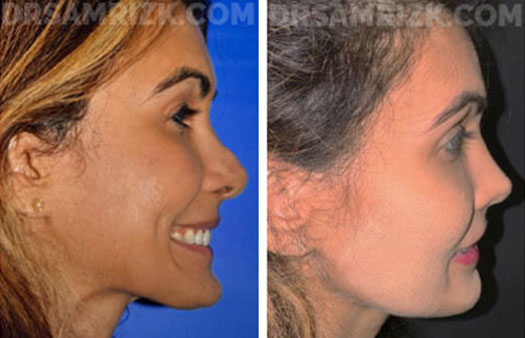
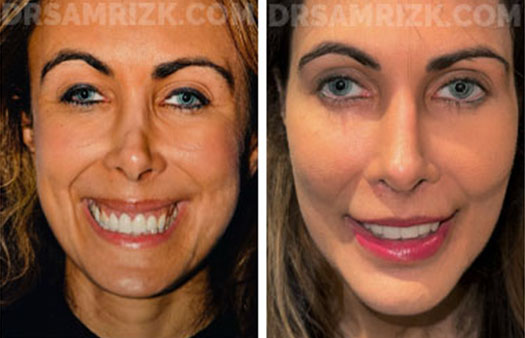
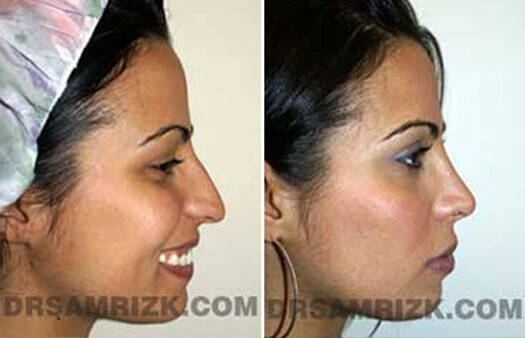
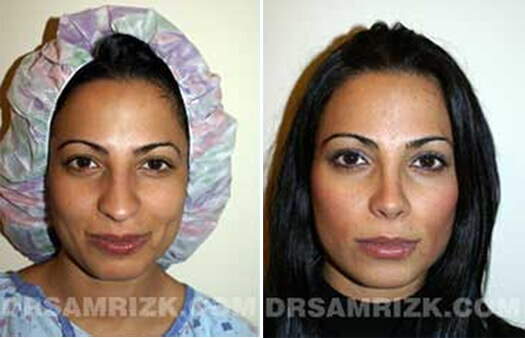
compliments a natural nose. A natural nose is also a nose that fits harmoniously with the rest of the face and in particular, the chin. Additionally, although there are certain standards for the size of the nose in relation to the face and eyes, this is a very artistic operation and Dr. Rizk recommends the patients see pictures of other noses the doctor they ultimately choose has performed and see if they agree with the surgeon's vision of a beautiful nose.
Your Consultation
Your consultation with Dr. Rizk will entail a thorough examination of the internal and external structure of the nose and how it relates to the face. A complete assessment of facial balance and chin-nasal-cheek proportions will be made. Photographs will be taken and reviewed with the patient with possible computer imaging performed. A review of what to expect before, during and after the rhinoplasty will be discussed as well and an offer to call other patients who have had rhinoplasty with Dr. Rizk who wish to share their experiences will be made. Finally, any questions you may have should be written and brought in with you during your consultation to ask Dr. Rizk who welcomes the prepared, informed patient.
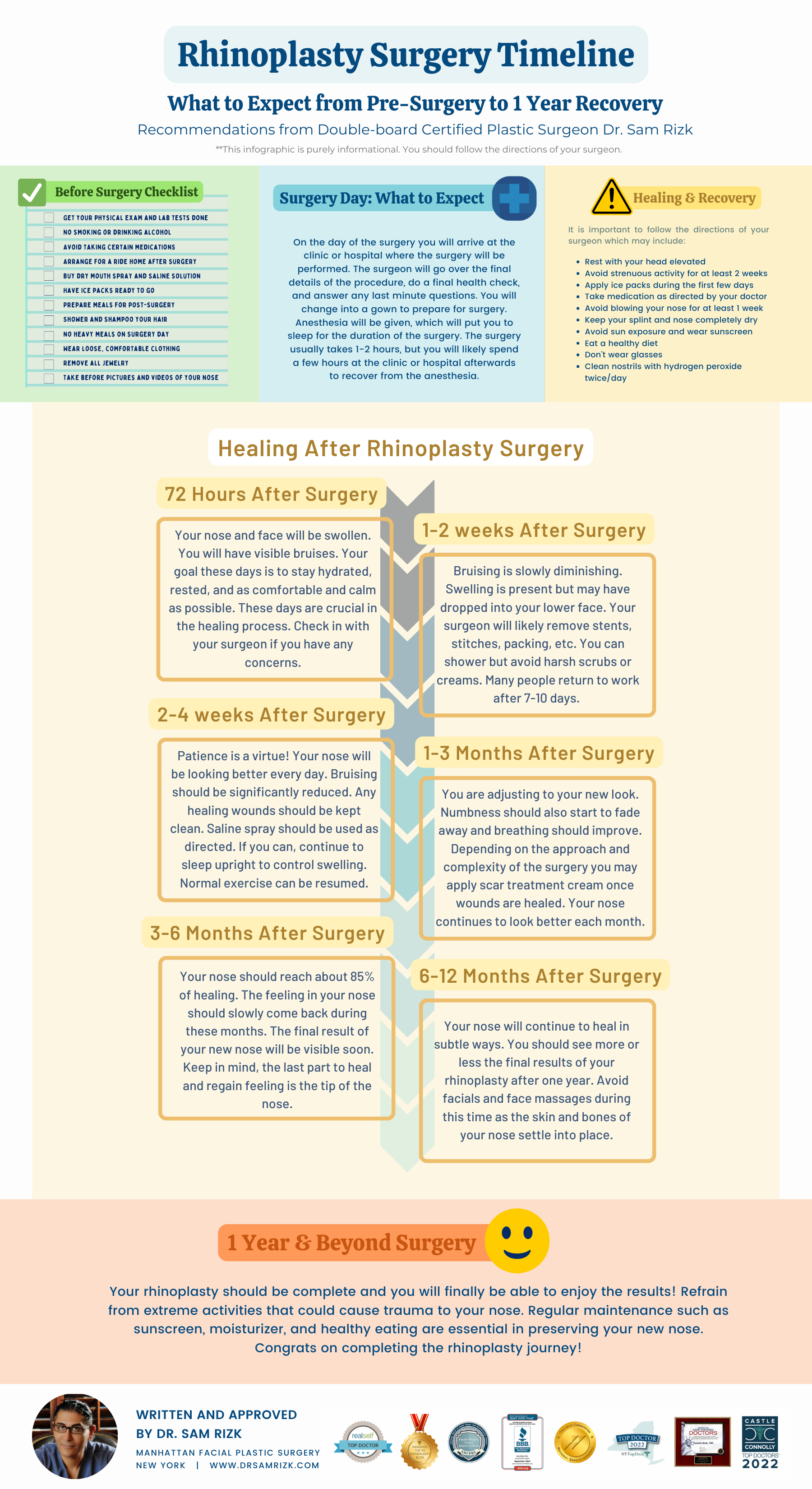
Rapid Recovery
With Dr. Rizk's high definition 3D approach, blood
vessels which may cause bruising are directly visualized and precisely
avoided to diminish bruising and swelling. One of Dr. Rizk's
innovations is also not closing all incisions inside nose completely,
which lets blood and fluid come out through gaps and not let blood and
fluid collect under the skin of the nose-these incisions close on
their own in first 5 days after surgery. Additionally Dr. Rizk
performs his sculpting deeper under muscle layers of nose which is a
clean plane of operating with fewer blood vessels. Also this results
in a more natural look because the muscle layer on top of the
cartilage and bone acts to soften the shape of the nose, eliminating
harsh edges. Finally, Dr. Rizk uses various tissue glues and herbal
supplements to result in a patient looking socially presentable in 5
days after the procedure with no pain, but just as important, is the
lesser degree of swelling in general which allows a better overall
result.
Revision Rhinoplasty
Noses which were done a long time ago may have
structural support defects and may be short, scooped out or overly
pointy. Dr. Rizk obtains cartilage from septum or ear (auricular) or
uses graft materials to restore structure and nasal
function. Typically, these patients also cannot breathe well and have
not only a cosmetic improvement after rhinoplasty but also have a
significant improvement in their breathing as well. As one of a
handful of surgeons who are double board certified in both
otolaryngology and facial plastic surgery, Dr Rizk routinely performs
at least a few revision rhinoplasty surgeries per week. When Dr. Rizk
adds cartilage grafts, he usually places another graft material on top
of them to soften their edges so the edges of cartilages are not
palpable or visible. This is another innovation to achieve a natural
outcome. The various grafts used in revision surgery by Dr. Rizk may
include a spreader graft, batton graft, caudal septal extension graft,
shield graft, tip graft or camouflage graft. Occasionally he will also
use a plumping graft to soften a very acute nasolabial angle.
How do you approach Revision Rhinoplasty Surgery?
50 percent of Dr. Rizk's rhinoplasties are revision surgery. Of the revision surgeries, 70 percent are done with the open approach and 30 percent with endonasal (closed) approach. However, Dr. Rizk finds that he can achieve a higher degree of precision and much more accurate results by using the 3-dimentional high definition telescope system for both open and closed approaches. This system, which Dr. Rizk introduced to rhinoplasty surgery, allows visualization of structures and areas difficult to see and based on density, can differentiate scar tissue versus fat versus bone or cartilage. This becomes important for changing structures or sculpting areas more accurately. Dr. Rizk is able to achieve excellent success with revision rhinoplasty. Dr. Rizk will only operate if he feels he can achieve a significant improvement. If Dr. Rizk decides that he cannot achieve a significant improvement, he will explain to the patient why he cannot do the surgery.
Septoplasty and Sinus Surgery
What nasal conditions lead to
difficulty breathing and how can it be corrected? What is a
septoplasty? How is sinusitis treated?
A deviated nasal septum (parting wall between right and left nasal
chambers) if significant (greater than 50%) can result in difficult
breathing and is treated with a septoplasty surgery. This can be done
as an isolated procedure or can be combined with sinus surgery or
rhinoplasty surgery.
Septoplasty is one of the most common procedures Dr. Rizk performs to
improve breathing. Dr. Rizk is double board certified in
otolaryngology and facial plastic surgery. Allergies can also result
in enlargement of the nasal tissue called turbinates and various
procedures can be performed to reduce the size of the turbinates. This
can be done with the septoplasty procedure alone or with the
septoplasty and rhinoplasty procedures together. Dr. Rizk will
determine if your turbinates are significantly enlarged and would
benefit from a reduction. Additionally, there may be polyps or other
nasal conditions which may be discovered on nasal exam which can
result in difficulty breathing. Dr. Rizk performs a thorough
intranasal exam to evaluate these conditions.
A CT scan may be recommended if Dr. Rizk suspects polyps or if you
have a sinus condition which is not getting better with medical
therapy. The first line of treatment is antihistamines and nasal
steroid sprays to shrink the nasal tissue. Allergy testing may also be
recommended. If your condition is persistent and not improving
endoscopic sinus surgery to drain the sinuses, turbinate reduction
and/or septoplasty may be recommended.
CLICK HERE FOR MORE INFORMATION
ABOUT SINUSITIS
Non-Surgical Nose Job
A non-surgical nose job is a media hyped term for putting a filler in the nose (Radiesse, Restylane or Juvederm) to try and camouflage a bump. What patients need to know is that this is more dangerous and more painful than actually having a rhinoplasty. The results are not permanent (Radiesse lasts at best one year, and Restylane/juvederm around 6 months). Moreover, you are making your nose larger and not addressing the tip, length or width of the nose. Fillers also create inflammation and scar tissue which can make a real nose job more difficult. These fillers can have adverse effects and can move in the nose (a central structure which is often bumped). For instance, a filler injected in a valley next to a bump to camouflage the bump can move into the bump and make it larger. Finally, Dr. Rizk's nose jobs are not painful and many times, bones need not be broken (the nose is mostly cartilage - not bone) and people look socially presentable after about 5 days of healing. Many patients agreed with Dr. Rizk that fillers can be more painful than a rhinoplasty.
The best role for fillers in the nose is to correct minor irregularities in a previously successful rhinoplasty, not as a replacement for rhinoplasty. Fillers work very well for other parts of the face because there is more soft tissue under skin to use them deeper and augment or erase facial creases, but there is very little soft tissue under skin of the nose to accomodate filler use, with certain
exceptions as discussed above.
Combined procedures
Dr. Rizk may recommend a chin implant, neck
liposuction, neck lift, facelift or eyelift at same time as
rhinoplasty surgery to improve overall outcome. Although rhinoplasty
is the most common operation in patients less than 25 years old, older
patients may benefit from a subtle improvement to correct an overly
long nose and this may compliment a facelift or eyelift. Changes in
rhinoplasty are not always dramatic and may be very subtle especially
in rhinoplasty on older patients. Male rhinoplasty patients are
accounting for an increasing number of Dr. Rizk's patient population.
Cost
A purely cosmetic procedure is never covered by
insurance. However, if a patient has difficulty breathing and is
found to have a deviated nasal septum or nasal allergy resulting in
enlarged turbinates may have the functional portion of the procedure
covered by insurance. A sinus condition may be treated at same
surgery as a rhinoplasty.
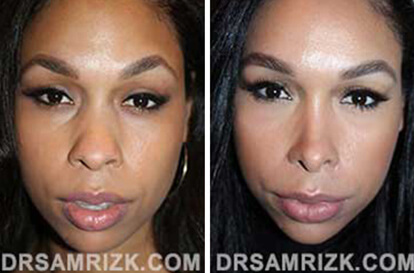
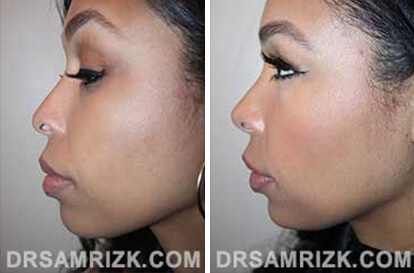
Thick skinned, Latin, Middle Eastern & African American Noses
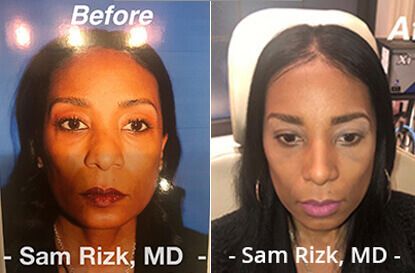
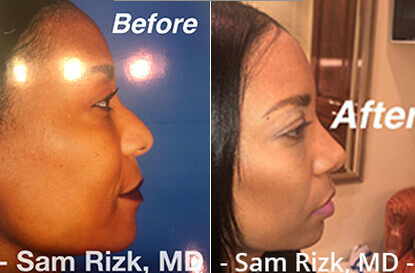
Some noses have weak cartilages and are short with thick skin. Dr. Rizk likes to achieve tip definition and support naturally by using the patients' own cartilage grafts either from their septum or ears. He also removes fat from the thick skin to make it thinner, using a high definition telescope system from small incisions inside the nose. Dr. Rizk finds that defatting these noses is crucial to acheiving a great outcome. Think of the skin as a covering blanket to the nose. If the blanket is thick, you will not be able to see the newly shaped underlying structure and definition. Also sometimes Dr. Rizk does a nostril defatting or reduction using small incisions inside the nose. He does not like to use an outside nostril scar due to the possibility of visible scars. He will sometimes add a dorsal graft to elongate a very short nose to make it look thinner. This graft is either the patient's own cartilage or a synthetic material called medpor. Dr. Rizk custom sculpts the medpor implant to fit your nose during your procedure, It is not a one size fit all implant. Dr. Rizk prefers not to use silicone grafts as they can move and do not integrate well into the nose. International patients usually need to stay in New York for one week after Rhinoplasty. An office concierge will arrange all accomodations. Patients have the option of using nurses after surgery at their hotels and we can provide those nurses.
Click here for more information.
Asian Noses
Most Asian noses require not only a dorsal graft but also tip grafting to achieve tip definition and projection (distance from base of nose to front portion of tip). Dr. Rizk prefers to use the patient's own cartilage from either ears or the nose's septum. Sometimes he will use medpor but not silicone. He likes to augment noses in a subtle way and reshape a nose to better match a patient's face. Very often, Dr. Rizk receives patients who were operated in Asian countries and who have silicon in their noses which moved or they feel it is too large for their faces. He usually removes the silicone implants and replaces them the with patient's own cartilage or a smaller medpor implant on dorsum. For the tip however, he prefers to use only the patient's own cartilage. Sometimes he will also do a nostril (ala) reduction in these patients to achieve balance and nasal-facial harmony which is important for a beautiful nose. Many times patients are able to return to their countries a week after their procedure. We can also provide nursing care in hotels post-operatively if so desired. Our office concierge will make your stay in New York for Rhinoplasty a pleasant one.
Click here for more information.
Do I need my nose broken during Rhinoplasty?
Not necessarily, Dr. Rizk does not break the nose in about 60 percent of procedures. As most of the nose is cartilage, sometimes breaking the nose to achieve narrowing of the bridge does not need to be done, dramatically expediting the recovery. Cartilage sculpting and suturing is done in most noses to narrow the tip or bridge. Depending on the percentage of noses which is cartilage versus bone determines whether it needs to be broken. During your consultation, Dr. Rizk would be able to assess this issue.
How does the nose age? What is the Aging rhinoplasty?
Dr. Rizk often does a minor rhinoplasty with a facelift or an eyelift to refine or rejuvenate the appearance. As we age, the skin in our nose becomes thicker and the nose "drops". What happens is the tip attachments to the dorsum (or top of the nose) weakens and the tip starts falling and this gives the appearance that one is developing a bump. However, this is usually a "relative" bump, meaning that it is a bump relative to the lower tip, and as the tip is lifted to a more youthful position, the bump disappears. This can be done with a minor soft rhinoplasty, without touching the nasal bones, and heals very quickly either as an isolated procedure or with other facial rejuvenation procedures. Sometimes, the tip is also refined at the same time as lifting it a little.
How does the male rhinoplasty differ?
Male noses have thicker skin and stronger bones and the aesthetics of the male nose is different. Male rhinoplasty has to address the thick skin in the nose to achieve excellent results. Also, removing the bump or lifting the tip has to be done very conservatively, in order not to feminize the appearance of the nose. Additionally, the nose has to fit other facial features of the male face to achieve a natural outcome. The angle between nose and upper lip in a male nose should not exceed 90 degrees, otherwise the nose appears too rotated or feminine. In the female nose, it should be 95 degrees or higher depending on the distance between nose and lips and other features. Male rhinoplasty accounts for 30 percent of Dr. Rizk's rhinoplasties.
Medical Articles:
NEW! Click here to read medical articles by Dr. Rizk, covering different conditions, techniques and technologies used in rhinoplasty.
Other Links:
|
|